
Why do I keep getting sick
every time I finally stop
The cold that arrives on day two of your annual leave. The flu that lands the week after a brutal quarter close. The cycle of feeling under the weather most of the year and then crashing properly the moment you finally rest. You take more vitamins. You sleep more. You wash your hands. And you keep getting sick anyway. If you've been asking why you're always getting sick, or why you're constantly getting sick despite doing everything right, you're not alone — and it's not bad luck or a weak immune system. It's a documented pattern called leisure sickness, and it's your body's report on a load you've been carrying without acknowledging. This page explains what's actually happening — and what changes when you address it at the root.
What "always getting sick" actually looks like
It's predictable, which is the first clue. The timing is too consistent to be random. You make it through the hardest weeks fine. You hold it together for the deadline, the launch, the close. Then you finally stop — and within 24 to 72 hours, something hits. A sore throat. A cold. A flu. A migraine. Sometimes a gut bug. Sometimes everything at once.
The second clue is the recovery curve. You crash hard on day one or two of the break. Spend half the holiday recovering. Start feeling human again around the time you need to go back. By the time you're at your desk on day one back, you're "fine" again. The cycle resets.
The third clue is the year-round low-grade pattern. Between the big crashes, you're rarely fully well. There's always something — a lingering sniffle, a sore throat that won't quite go, a fatigue that has no specific name. Some people describe it as "why do I always feel sick" — the constant low-grade sense of being not quite well. You've normalised this as your baseline. Most people around you have too.
The fourth clue is frequency. If you keep getting colds every 2 weeks, or feel like you're getting sick so often that it's become part of your identity, that's not immune weakness in the traditional sense. That's a nervous system that hasn't been allowed to recover between challenges.
For high performers this pattern often runs for years before being recognised as a pattern at all. It gets filed under "I just have a weak immune system" or "I always get sick on holiday — it's a running joke". Neither explanation accounts for why the timing is so consistent. And neither addresses what's actually generating it.
What most advice gets wrong when
you're constantly getting sick
The standard playbook is well-known: take vitamin C, get more sleep, eat better, exercise more, manage stress, wash your hands, get the flu shot, take immune-boosting supplements. For acute illness with a clear external cause, these tools work as designed.
For the chronic, predictable pattern of always getting sick, they consistently miss the actual mechanism. You can take vitamin C every day and still crash on day two of holiday. You can sleep eight hours and still wake up with a sore throat every quarter close. You can do everything right and still find yourself sick on every break.
The reason these interventions fall short is that they treat the immune system as the problem. For most people who keep getting sick despite doing everything right, the immune system isn't weak — it's been actively deprioritised. Your body is making a decision, every day, about where to allocate finite resources. When the nervous system is chronically activated, immunity gets sent to the back of the queue. The body is triaging you. And it's triaging immunity out.
Why you're always getting sick —
and why it's not your immune system
Here's what's actually happening: your immune system is downstream of your nervous system. When the nervous system is chronically activated — sympathetic dominance, the "go" state — the body suppresses immune function because, evolutionarily, fighting infection isn't a priority when you're being chased by a tiger. Your body has been treating the entire year like an extended tiger encounter. So immunity has been held back the whole time.
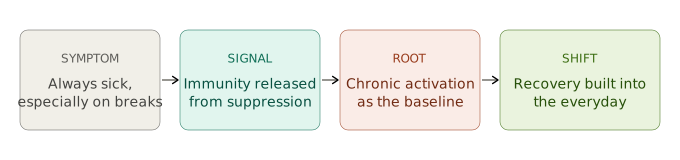
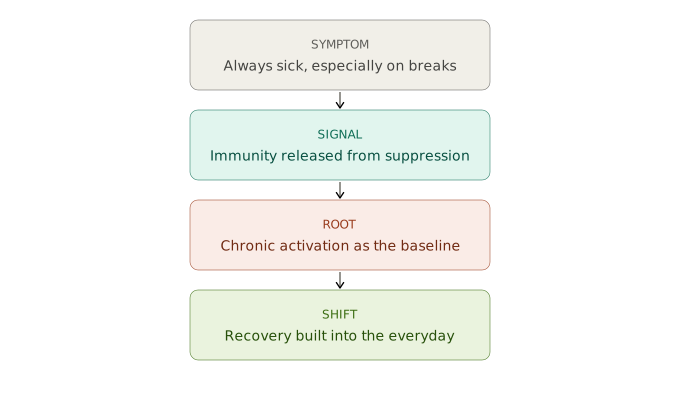
The crash on day two of holiday isn't because your immune system failed. It's because your immune system finally got permission to do its job. The parasympathetic nervous system kicks in. The body downshifts. And every infection it's been holding off — the low-grade virus, the bacterial niggle, the inflammation that's been bubbling — all of it gets to surface and resolve. It looks like getting sick. It's actually catching up.
This phenomenon has a name in the research literature: leisure sickness. Coined by Dutch psychologist Ad Vingerhoets in 2002, it describes the documented pattern of people developing physical symptoms specifically during weekends, holidays, and vacations — particularly people with high workload, high responsibility, and difficulty transitioning out of work mode.
The default underneath this is a chronic stress pattern that the person has normalised. "I'm always a bit under the weather" is not a personality trait. It's a physiological report on your baseline state. The body has adapted to run on emergency fuel, and the immune crash is what happens the moment the emergency stops.
There's often a deeper layer for high performers: the belief that you can't afford to slow down without crashing. So the only time the body gets permission to recover is when external structure forces it — a holiday, a weekend, a forced break. And every time, the body uses that window the only way it knows how: by crashing. The pattern becomes self-reinforcing.
Your body isn't betraying you on holiday. It's finally being allowed
to do what it's been trying to do all year.
Sources: Leisure sickness: a pilot study on its prevalence, phenomenology, and background (Vingerhoets, Van Huijgevoort, Van Heck — Psychotherapy and Psychosomatics, 2002)—PubMed
Current Directions in Stress and Human Immune Function," Current Opinion in Psychology, Morey, Boggero, Scott & Segerstrom (2015)— PMC
What changes when the pattern is addressed
When the chronic stress pattern is addressed and the baseline nervous system state shifts from high-alert to regulated, the immune system gets the resources it was being denied. The body no longer needs a crash to recover — recovery is built into the baseline.
People stop getting sick on holiday because the holiday is no longer the only time their system is allowed to recover. They stop getting sick at quarter-end because the build-up to quarter-end isn't depleting them the same way. The "always a bit under the weather" baseline lifts. And they realise, often with some surprise, that they don't get sick much anymore — and when they do, they recover faster.
The pattern of "I'll rest when it's over" stops being necessary because the system is no longer running on emergency fuel. Resilience becomes physical as well as mental. People notice it in things they hadn't connected: sleeping better through stressful periods, recovering faster from setbacks, staying well through the seasons that used to always take them down.
This is one of the most under-rated outcomes of the work — and one of the easiest to verify. The body keeps the score. Track how often you get sick over a year of pattern work versus the year before. The difference tends to speak for itself.
(Explore the approach behind this work)
Sources: Psychological Stress and the Human Immune System: A Meta-Analytic Study of 30 Years of Inquiry (Segerstrom & Miller, Psychological Bulletin, 2004) — PMC
Your immune system isn't broken.
The pattern underneath it is.
Lead Yourself First.
Why do I keep getting sick all the time?
For most people who keep getting sick despite good sleep, good diet, and good hygiene, the cause isn't external — it's internal. Chronic nervous system activation suppresses immune function. Your body is deprioritising immunity in favour of managing perceived stress. When the stress pattern changes, the immune system gets the resources it was being denied — and the pattern of always getting sick tends to resolve.
Why am I getting sick so often lately?
If you're getting sick more frequently than you used to, something has shifted in your nervous system baseline. Either the load has increased or your capacity has decreased. The most common driver is sustained activation without genuine recovery — the "on" state has become chronic, and the immune system has been triaged out of the resource queue. Once the baseline changes, the frequency changes with it.
Why am I always getting sick every time I take a holiday?
This is a documented pattern called leisure sickness — first identified by Dutch researcher Ad Vingerhoets in 2002. When you're under chronic stress, your nervous system suppresses immune function to prioritise the perceived threat. The moment you stop, the body finally has permission to address the infections and inflammation it's been holding off. The crash isn't a malfunction — it's a delayed response. The fix isn't to boost immunity. It's to address why the immunity was being suppressed in the first place.
Why do I keep getting colds every 2 weeks?
Because the underlying pattern generating them is running every day. If you're catching colds this frequently, your immune system isn't getting sustained recovery windows. It's cycling through low-grade suppression and brief recovery attempts, never fully resetting. This is one of the clearer signals that the nervous system pattern needs addressing, not the immune system itself. When the chronic activation lifts, the frequency drops sharply — often within weeks.
Why do I always feel sick even when I'm not really ill?
The "always feeling sick" pattern — low-grade unwellness, lingering symptoms, general malaise without a clear illness — is often a low-level immune activation. The body is running low-grade inflammation because the nervous system is running high-grade stress. It's not a diagnosable illness. It's a physiological state. And it doesn't respond to standard treatment because there's nothing to treat — until you address the state underneath.
Can stress really weaken my immune system?
Yes — this is well-established in the research literature. Chronic stress drives cortisol production, which suppresses inflammatory and adaptive immune responses over time. It also disrupts sleep, gut function, and recovery — all of which compound the immune effect. The relationship between chronic stress and reduced immune function is one of the most robustly documented links in psychoneuroimmunology.
Is it normal to get sick during vacation?
Common, but not normal. It's a signal that your nervous system has been operating in sustained high-activation mode and is using the only recovery window it's been given. If this pattern is consistent, it indicates that your baseline state needs to change — not that you need a longer holiday. The goal isn't to be someone who manages holiday sickness better. The goal is to stop needing the crash.
What's the difference between constantly getting sick and having a weak immune system?
"Weak immune system" implies a clinical deficit that would show up on tests — low immunoglobulins, specific deficiencies, autoimmune conditions. Chronic constant sickness in high performers usually comes back normal on those tests. That's because the immune system isn't clinically weak — it's being deprioritised by the nervous system. The tests measure capacity. They don't measure the allocation of that capacity. When the allocation changes, the sickness pattern changes.
Related signals
Fatigue that sleep doesn't fix
If your immune system is in the queue, your energy probably is too. The same chronic activation that keeps you getting sick is what leaves you exhausted regardless of how much you sleep. Two reports from the same system.
Nervous stomach, bloating, and gut issues
Chronic stress doesn't just suppress immunity — it disrupts the gut, which is where most of your immune function actually lives. If you get sick constantly and your gut is also struggling, that's not coincidence. That's one pattern, two locations.
Sunday dread that steals your weekend
If Sundays are heavy and you crash on Monday's day off, that's the same nervous system that keeps you sick on holidays. The dread and the sickness are two versions of the same signal: your body needs recovery it isn't getting during the week.