
Why am I so irritable all the time
You held it together all day. The difficult colleague, the missed deadline, the situation that should have been easier than it was. You were measured. Composed. And then someone at home asked a perfectly reasonable question — and something came out of you that you didn't intend. You apologised. You felt bad. You told yourself it wouldn't happen again. And it did. If you're searching for why you're so irritable all the time, it's not because something is wrong with you. It's because something is full. This page explains what.
What this kind of short temper actually feels like
The snap itself is usually disproportionate. Small thing, large response. Someone asks where you put something. A child makes noise at the wrong moment. A partner mentions something they've mentioned before. And the reaction that comes out is bigger than the situation warrants — sharper, colder, or shorter than you meant.
What follows is familiar: the immediate awareness that it was too much. The guilt. Sometimes an apology. A quiet resolve to do better. And then — because the resolve doesn't address what generated the snap — it happens again.
What makes this particularly hard is the asymmetry. You can hold your composure through brutal situations all day. You handle pressure well. And then you snap at someone you love over something trivial, and the gap between those two versions of yourself is genuinely confusing.
The irritability isn't constant. It builds. Mornings are usually okay. By late afternoon the fuse is shorter. By evening you've got nothing left. The people who get the worst of you aren't strangers — they're the people closest to you.
What most advice gets wrong about how
to control anger issues
The standard approach to anger issues focuses on the moment of snapping: pause before responding, count to ten, take a breath, communicate your needs, practise anger management. These are reasonable tools for the moment of discharge.
They don't work long-term because they address the exit point, not the source. Managing the snap is like putting a better lid on an overfull container. It helps temporarily. But the container is still full. And it will find another exit.
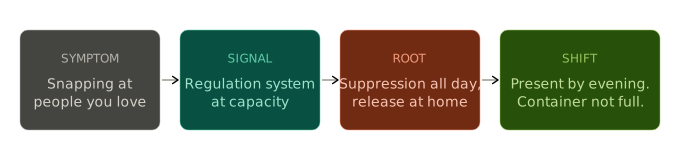
The reason conventional anger management offers limited relief is that it treats irritability as an anger problem — something to be controlled, suppressed, or redirected. It isn't. Short temper and getting angry easily are usually capacity problems, not anger problems. The emotional regulation system has been running at full load all day, and by the time you get home there is simply nothing left to regulate with. The snap isn't the problem. It's the report.
This is the part most anger control content misses: you can't manage your way out of a capacity issue. You can only address what's draining the capacity in the first place.
You're not an angry person. You're a full one.
Here's what's actually happening: the emotional regulation system — the part of the nervous system responsible for modulating your responses — is a finite resource. All day, in every interaction that requires composure, you are drawing on it. Staying calm. Managing how you come across. Containing frustration, absorbing pressure, holding space for others. Every one of those acts costs something.
By the time you get home, the container is full. Not because you're an angry person. Not because you don't love the people around you. But because you've spent the entire day containing emotions that never got processed — and the body is now looking for the nearest, safest exit.
The reason it happens at home and not at work is precisely because home is safe. You don't lose it with clients or strangers because the cost is too high. You lose it with the people you trust most because unconsciously, they're the ones you don't have to perform for. It's not a betrayal of love. It's the inverse of it.
The default underneath this is emotional suppression and release. Emotions stored rather than processed during the day — because the environment demands containment — eventually discharge through the path of least resistance. Until the suppression pattern changes, the release pattern will continue.
The snap is not who you are. It's what happens
at the end of a day of being someone else.
What changes when the pattern is addressed
When the suppression and release cycle is replaced with genuine emotional processing during the day — not therapy-style excavation, but simple, regular discharge — the container stops filling to the brim. There is space left by evening. The small thing is just a small thing.
The snap stops. Not because you became more patient through effort or willpower. But because the emotional load you were carrying into the evening has somewhere to go before it reaches that point.
People describe a qualitative change in their relationships that they didn't expect from pattern work. Their partners notice. Their children notice. There's a person actually present in the evening rather than a depleted version managing their way through it. The irritability that had become a familiar feature of your evenings stops being part of who you are. (Here's how that work actually happens.)
Sources: Neurobiological effects of chronic stress — NCBI
You're not an angry person.
The pattern underneath it is.
Lead Yourself First.
Why am I so irritable all the time?
Because your emotional regulation capacity has been running on empty without you noticing. Irritability is rarely random — it's a signal that the system is at capacity. If you find yourself snapping at small things, losing patience faster than you used to, or feeling like you have a shorter fuse than you used to have, the cause is usually not the things you're snapping at. It's the accumulated load you're carrying that left no room for anything else.
Why am I getting angry so easily lately?
Because something has shifted in your baseline. Either the load has increased (more work, more stress, more responsibility) or your capacity has decreased (poor sleep, missed recovery, accumulated unprocessed emotion). When the gap between load and capacity narrows, the same small triggers that used to roll off start landing harder. It's not that you've become more reactive. It's that you have less room to absorb without reacting.
How do I control anger issues at the root?
Most anger management techniques target the moment of discharge — the snap, the outburst, the reaction. They help temporarily, but they don't change why the anger keeps building. Lasting change requires addressing what's filling the container during the day. If you address the suppression pattern that's generating the load, the anger reduces naturally. You don't have to manage it because there's less of it to manage. That's a different path than conventional anger control — and for most people, it's the one that actually holds.
Why do I have such a short temper all of a sudden?
A short temper that arrives suddenly is almost always a capacity signal, not a personality change. Something has changed in your baseline — either the load has gone up or your reserves have gone down. The fuse shortens when there's less buffer between the trigger and the reaction. If your short temper is new and persistent, the question isn't "how do I control it" — it's "what changed?" Usually it's a combination of sustained stress, missed recovery, and emotional load that's been accumulating without an exit. Addressing those changes the fuse length naturally.
How do I stop snapping at people?
Short-term: notice the build-up earlier in the day, before evening. Long-term: address what's filling the container during the day. Snapping isn't a willpower problem. It's a capacity problem. You can't will yourself into more emotional bandwidth — you have to stop spending it without realising.
Is being easily irritated a sign of stress or burnout?
Often both. Sustained stress depletes the emotional regulation system, which shows up as a shortened fuse. If the irritability is new and persistent, it's worth taking seriously as a signal that your current load isn't sustainable. It's one of the earliest reliable indicators that burnout is on the way — and one of the most useful, because it gives you a chance to intervene before the crash.
Related signals
Fatigue that sleep
doesn't fix
Same depletion, different exit. When the day has cost you everything, the people closest to you get whatever's left. The short fuse and the exhaustion are two reports from the same empty container.
Nervous stomach,
bloating, and gut issues
Suppressed stress doesn't stay contained. The snap at home is one exit. The gut is another. Same pattern landing in different places — and one tends to make the other louder.
Overthinking loops that go nowhere
The guilt after snapping often triggers its own loop — replaying what happened, what you should have said, what it says about you. Same nervous system, different expression. The snap and the spiral are connected.