
How do I stop overthinking
when nothing else has worked
You've thought about it thirty times. You have all the information you need. And you're still circling. The decision doesn't get clearer. The plan doesn't get better. The email doesn't get sent. If you're searching for how to stop overthinking, you've probably already tried the standard advice — meditation, journaling, decision deadlines, mindfulness apps. They help for a few days, then the loop returns. This page goes deeper than tips. What causes overthinking, why thinking your way out doesn't work, and what changes when you address the root.
What overthinking and racing thoughts actually feel like
It's not confusion. You usually know what you think. It's the circular return to the same territory — the same decision, the same conversation, the same problem — without resolution. Each pass feels like it might be the one that finally settles it. It never is.
The loop tends to activate most in the moments that matter most. Before a high-stakes conversation. After a decision that can't be undone. Late at night when there's nothing to distract from it. Racing thoughts at night are often the same loop that was running during the day, just without the work distractions that normally masked it.
What makes this particularly exhausting is that it feels productive. You're thinking hard. You're being thorough. You're not avoiding — you're preparing. Except nothing gets decided. Nothing gets done. And the energy spent circling is energy that won't be there when you need to act.
The pattern often runs for years before being recognised as a pattern at all. It gets reframed as diligence, thoroughness, or being thoughtful. None of which is wrong. None of which addresses what's actually happening.
What most advice gets wrong about how to stop overthinking everything
The standard approach treats overthinking as a thinking problem — too many thoughts, too much analysis, too little mindfulness. The prescription follows: journal it out, set a decision deadline, do a pros and cons list, meditate, breathe, name-it-to-tame-it.
These tools aren't useless. But they address the surface activity — the looping thought — not what's generating it. A pros and cons list doesn't resolve the fear of being wrong. A decision deadline doesn't touch the underlying belief that more thinking equals more safety. Mindfulness can create temporary distance from the loop, but without addressing the root, the loop restarts.
The reason conventional advice offers limited relief is that overthinking isn't a cognitive surplus. It's an emotional response wearing the costume of rational analysis. And you can't think your way out of a pattern that thinking is generating.
What causes overthinking,
and why it's not what you think
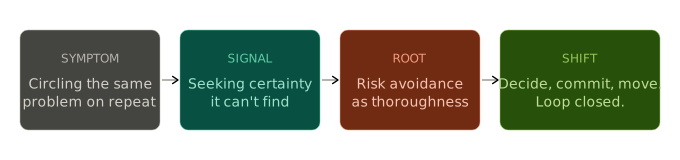
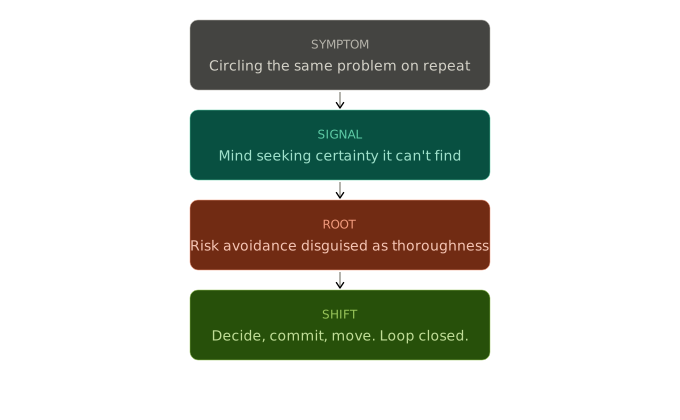
Here's what's actually happening: the mind is circling because it doesn't feel safe to stop. Underneath the loop is a fear — of being wrong, of being judged, of being caught out, of making the call that turns out to be the wrong one. The thinking isn't solving the problem. It's managing the anxiety of having to decide.
This is the risk-avoidance pattern disguised as thoroughness. The brain has learned that as long as it keeps thinking, the decision hasn't been made yet — and as long as the decision hasn't been made, it can't be wrong. The loop is protection. It just costs everything.
There's often a second layer specific to people who identify as thoughtful or capable: the belief that the quality of their thinking is tied to their value. Smart people think carefully. Thorough people consider every angle. If the loop feels like intelligence, stopping it can feel like becoming someone less capable. That belief is the deeper root. And it's what keeps the loop running long after you know, logically, that you need to just decide.
Overthinking isn't a thinking problem. It's what happens when the mind tries to find certainty in a situation that doesn't offer it.
Why racing thoughts at night are worse than overthinking during the day
The loop runs in the day too. But during the day, work and activity mask it. There's always another email, another meeting, another task pulling your attention forward. The thinking circles in the background, but you don't have to sit inside it.
At night, the distractions stop. The lights go out. And the loop becomes the only thing in the room.
This is why racing thoughts at night are often more intense than the same thoughts during the day. The content is the same — the unresolved decision, the conversation you're replaying, the situation you can't quite settle — but the volume is louder because there's nothing else competing for your bandwidth. And because sleep itself feels at stake, the urgency to "solve it now" rises, which only makes the loop tighter.
The standard advice for racing thoughts at night — sleep hygiene, magnesium, blue light filters — addresses sleep architecture. It doesn't touch what your mind is doing in the dark. The thoughts aren't a sleep problem. They're a daytime problem that becomes audible at night, when there's nothing left to drown them out.
Source: Insomnia, Pre-Sleep Arousal, Psychosocial Factors and Changes in Sleep Pattern during the Second Wave Lockdown of the COVID-19 Pandemic in Georgia (Lortkipanidze et al., 2022) — PMC
What changes when the pattern is addressed
When the risk-avoidance pattern is addressed at its root — the fear of being wrong, judged, or exposed — the loop collapses. Not because the person becomes reckless or stops thinking carefully. But because they develop a different relationship with uncertainty.
Decisions that took weeks start taking hours. Sometimes minutes. The process of thinking through something still happens — but it reaches a natural conclusion rather than restarting. People describe a new capacity to make a call, commit to it, and move without the loop restarting behind them.
The racing thoughts at night reduce. Not because of better sleep hygiene, but because the daytime stops generating the backlog that previously surfaced at 11pm. The mind doesn't have unresolved material to circle when the loops have actually closed.
The relief of being someone who decides is significant. And the energy that was spent circling becomes available for what comes after — which turns out to be where most of the actual value was waiting. (Here's how that work actually happens.)
Sources: Prefrontal regulation and decision execution — PMC
Your thinking isn't broken.
The pattern underneath it is.
Lead Yourself First.
How do I stop overthinking everything?
Not by thinking less. By addressing what the thinking is for. Most chronic overthinking isn't a thinking surplus — it's a fear response that uses thinking to delay action. When the fear is addressed, the loop closes naturally. Trying to stop the thinking directly tends to make it louder, because you've added a new thing to think about.
What causes overthinking?
At root, the most common cause is fear — of being wrong, of being judged, of making the call that turns out badly. The mind circles because circling delays the decision, and an unmade decision can't yet be a mistake. The thinking isn't trying to solve the problem. It's trying to keep the threat of being wrong at distance. That's why more information rarely settles it: the issue was never information.
Is overthinking a sign of anxiety?
They share the same root: a nervous system that has learned to treat uncertainty as threat. Overthinking is often how that threat response shows up in people who are too functional to call it anxiety, but whose minds never fully stop running. It's the same pattern, more socially acceptable packaging. If your overthinking is severe, persistent, or accompanied by panic symptoms, it's worth a clinical assessment. But low-grade chronic overthinking is more usefully understood as an anxiety pattern than as a separate condition.
How do I stop racing thoughts at night?
Short-term: when the loop starts at night, don't fight it or try to solve it. Get up briefly, write the content down to externalise it, and return to bed. This signals to the brain that the material is captured. Long-term: address why those thoughts had nowhere to go during the day. Racing thoughts at night are usually unresolved daytime material surfacing. When the daytime stops generating the backlog, the night stops being where you process it.
What causes racing thoughts at night specifically?
The same root causes as daytime overthinking — fear of being wrong, unmade decisions, unresolved conversations — surfacing when there's no longer anything else to mask them. During the day, work and activity keep the loop in the background. At night, the distractions stop and the loop becomes the only thing in the room. The volume isn't higher at night. The room is just quieter.
Can decision paralysis be cured?
Cure isn't quite the right frame. The thinking capacity that drives the loop is also what makes you effective in many other ways — the ability to consider angles, anticipate problems, think carefully. The goal isn't to remove that. It's to address the fear that turns useful thinking into a loop that never lands. When the root changes, the thinking stays. The circling stops.
Related signals
Waking up at 3am with your mind already racing
The 3am racing thoughts and the daytime overthinking loops are the same pattern at different hours. If your mind circles at 3am, it probably circles at 3pm too. Different time. Same root.
Chronic headaches and pressure behind the eyes
Every unresolved loop consumes bandwidth. By mid-afternoon, the pressure builds. The headache isn't from dehydration. It's the felt sense of a brain running too many open processes at once.
Procrastinating on the things that matter most
Overthinking and procrastination are often the same pattern in different directions. One avoids starting. The other circles endlessly without landing. Both protect against the same thing: being wrong about something that matters.