Why you keep waking up
at 3am every night
Eyes open. Dark room. And before you've moved, your mind has already loaded the meeting, the conversation you didn't have, and the decision you've been deferring. It's 3am. Nobody asked for this. If you're asking why you keep waking up at 3am, you're not alone — it's one of the most recognisable patterns in chronic stress. The standard explanations (cortisol, blood sugar, hormones) capture pieces of it without explaining why it keeps happening to you specifically. This page goes deeper. What's actually running underneath, why conventional fixes miss, and what changes when you address the root.
The shift from "Waking up at 3am is one of..." to "If you're asking why you keep waking up at 3am..." mirrors exact search intent and integrates the long-tail keyword naturally.
What waking up at 3am actually feels like
It's specific in a way that becomes familiar. You don't drift slowly toward consciousness. You're suddenly awake — alert, mind already moving. Sometimes there's a physical sensation that came with it: a jolt, a feeling of being startled, a sense of cortisol already moving through the body before any thought arrives.
Then the thoughts start. Not random ones. Not creative ones. The mental list of everything unresolved: the conversation you've been avoiding, the decision you keep deferring, the situation at work, the thing you didn't say yesterday. Your brain works through them with strange efficiency at 3am. None of the solutions feel useful in the morning.
What makes this particularly punishing is the recovery curve. You usually fall back asleep eventually — sometimes after an hour, sometimes after three. But the sleep that follows is shallow and short. By 7am you've been technically asleep but functionally awake for most of the night. The day starts with a deficit that compounds across the week.
What most advice gets wrong about nighttime anxiety
The standard explanations focus on physiology: cortisol peaks in the early hours to prepare you for the day, blood sugar drops, melatonin fades, sleep cycles shift. All of this is true. None of it explains why your brain immediately loads the unresolved list rather than just letting you drift back to sleep.
The conventional advice follows: better sleep hygiene, avoid alcohol, magnesium supplements, cooler room, consistent bedtime, no screens before bed. For occasional sleep disruption, these work. For chronic 3am wake-ups, they consistently fall short — because the wake-up isn't the problem. The racing thoughts that follow are.
The reason most advice misses is that it treats this as a sleep disorder. For most people with chronic 3am wake-ups, sleep architecture isn't the issue. The issue is what the brain does once it briefly surfaces between sleep cycles. A regulated nervous system surfaces, registers nothing urgent, and drifts back. A dysregulated nervous system surfaces and immediately loads everything it couldn't process during the day.
The most common explanation goes like this: your body has a natural cortisol awakening response.
You don't wake up at 3am because of cortisol.
You wake up because your day didn't close.
Here's what's actually happening: cortisol does peak in the early hours — that part of the conventional explanation is correct. In a regulated system, this peak is gentle and well-timed, easing you toward waking. In a chronically stressed system, the peak arrives harder, and the moment it spikes, the mind loads the most unresolved items first.
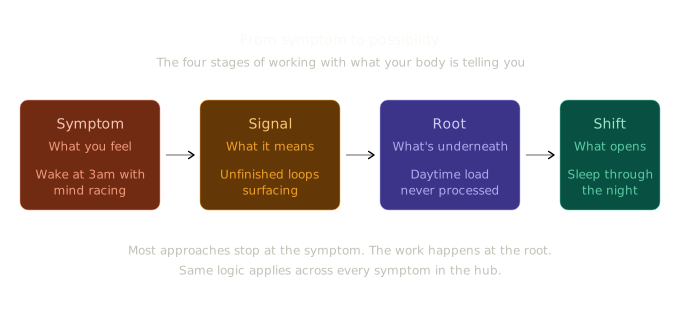
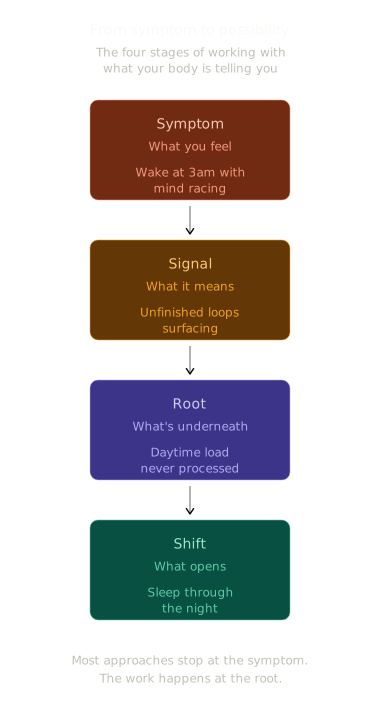
This is an unfinished loop pattern. Throughout the day, the conscious mind suppresses, defers, and rationalises. The decisions that didn't get made. The conversations that didn't happen. The tensions that got swallowed. None of it disappeared — it just got pushed to the side. At 3am, when the conscious mind is briefly out of the way, the unconscious surfaces it all.
Your brain isn't malfunctioning at 3am. It's catching up. The loops you didn't close during the day are getting processed when the system has a quiet window. The problem isn't that this happens. The problem is that the volume keeps increasing because the loops keep accumulating.
The default underneath this is suppression-as-coping. The mental strategy of "I'll deal with it later" works during the day. It collapses at 3am, because later has arrived — just at the wrong time, with no resources to actually deal with anything.
Your brain isn't broken at 3am. It's the only honest part of you left awake.
What changes when the pattern is addressed
When the unfinished loop pattern is resolved — through processing what was suppressed, making decisions that were avoided, and building a daily pattern of closure — the 3am wake-up stops. The cortisol peak still happens, but it meets a system with nothing urgent loading.
People sleep through. And when they do wake naturally, there's an absence of that immediate dread — a quietness at the start of the day that often feels foreign for years before it becomes the new normal.
The deeper shift is what changes about the day before the night. When loops get closed regularly — decisions made, conversations had, tensions named — the day doesn't accumulate the way it used to. By bedtime there's less unfinished business waiting to surface. Sleep becomes recovery rather than another battleground. (Here's how that work actually happens.)
The 3am wake-up was never the problem. It was the report card. And once the system shifts, the report changes too.
Source: Sleep quality and emotional processing — PMC

Your sleep isn't broken.
The pattern underneath it is.
Lead Yourself First.
Why do I keep waking up at 3am every single night?
Because it's not a one-off — it's a pattern your nervous system has learned. The wake-up keeps happening at the same time because the underlying mechanism is the same every night: cortisol rises in the early hours, and your unconscious uses that window to surface what wasn't processed during the day. The consistency isn't a coincidence. It's a signal that the daytime backlog is consistent too. The wake-ups will keep happening until the daytime pattern changes.
What does it mean when you wake up at 3am with racing thoughts?
It means your brain is using the only window it has to process unresolved material. Throughout the day, the conscious mind keeps a lid on what hasn't been addressed. When that lid loosens at 3am, everything surfaces at once. The racing thoughts aren't a problem to solve — they're a signal that the daytime processing isn't happening.
How do I stop waking up with anxiety at 3am?
Two paths work together. Short-term: when you wake, don't fight the thoughts or try to solve them. Write them down briefly to externalise them, then return to bed. Long-term: address why those thoughts had nowhere to go during the day. The wake-ups stop when the daytime stops generating the backlog.
Is waking up at 3am a sign of high cortisol?
Cortisol is part of the picture, but it's not the whole picture. The cortisol awakening response happens for everyone — it's part of normal sleep architecture. What differs in chronic 3am wake-ups is what your mind does in response to that cortisol peak. A regulated system meets it with calm. A dysregulated system meets it with the unprocessed contents of yesterday.
Related signals
Overthinking loops that go nowhere
The 3am racing thoughts and the daytime overthinking loops are the same pattern at different hours. If your mind circles at 3am, it probably circles at 3pm too.
Sunday dread / Monday heaviness
The 3am wake-up gets worse on Sunday nights for a reason. Same nervous system, same unprocessed material, different trigger.
Chronic headaches and pressure behind the eyes
If you wake up at 3am with your mind already racing, chances are the pressure behind your eyes is building by mid-afternoon. Same cognitive overload, different hour, different report.