
What causes chronic tension headaches every single day
The dull band across your forehead. The pressure that sits behind your eyes by mid-afternoon. The headache that's there most days, sometimes worse on Sunday evenings, sometimes worse after a hard week — but never quite gone. You've tried water, ibuprofen, posture, sleep, and probably every tension headache treatment your doctor or pharmacist suggested. Some of it helps temporarily. None of it stops the pattern from coming back. Chronic tension headaches aren't a hydration problem or a screen-time problem. They're a signal your brain is running too many unresolved loops simultaneously. This page explains what's actually causing them, why standard treatment falls short, and what changes when you address the root.
What daily tension headaches actually feel like
It's not the sharp, pulsing pain of a migraine. It's something subtler and more persistent — a low-grade pressure that wraps around the head, often most intense across the forehead and behind the eyes. Sometimes it extends down into the neck and upper shoulders. Sometimes the temples feel tight, as if something is pressing inward.
The timing tends to follow a pattern. The morning is often clear. By late morning or early afternoon, the pressure begins to build. By 5pm you're aware of it. By evening it's harder to ignore.
What makes chronic tension headaches particularly disorienting is the absence of an obvious trigger. You weren't dehydrated. You slept well enough. You didn't skip meals. You just had your day. And by the end of it, your head is heavy in a way that no glass of water or paracetamol fully resolves.
This pattern often runs for years before being recognised as a pattern at all. It gets filed under "I just get headaches" or "I need to drink more water." Neither explanation accounts for why the headaches don't actually respond to those interventions.
Why standard tension headache treatment
fails for chronic sufferers
The standard tension headache treatment protocol is well-documented: drink more water, fix your posture, reduce screen time, take magnesium, use a cold compress, try over-the-counter pain relief. For clinical cases, a doctor might prescribe muscle relaxants, tricyclic antidepressants, or refer you to physical therapy. For occasional headaches with a clear trigger, these tools work as designed.
For chronic, near-daily tension headaches, they consistently fail to resolve the pattern. The headache improves briefly, then returns. The dehydration explanation doesn't hold up when you've been hydrated all day. The posture explanation doesn't hold up when you've corrected it. The screen explanation doesn't hold up when you spent the weekend offline and the headache still arrived.
The reason chronic tension headaches treatment usually falls short is that it assumes the headache is a downstream effect of a physical input — water, posture, light, muscle tension. For chronic sufferers, that's not what's happening. The headache is a downstream effect of cognitive overload. The body is reporting a load the mind has been carrying without acknowledging.
You can medicate the symptom. You can relieve the pressure temporarily. Neither addresses what's generating the pattern in the first place. That's why chronic sufferers cycle through treatments for years without lasting change — the treatment is aimed at the wrong layer.
What causes tension headaches everyday —
and why it isn't dehydration
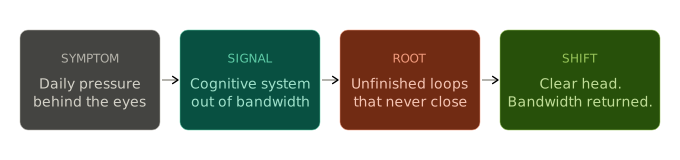
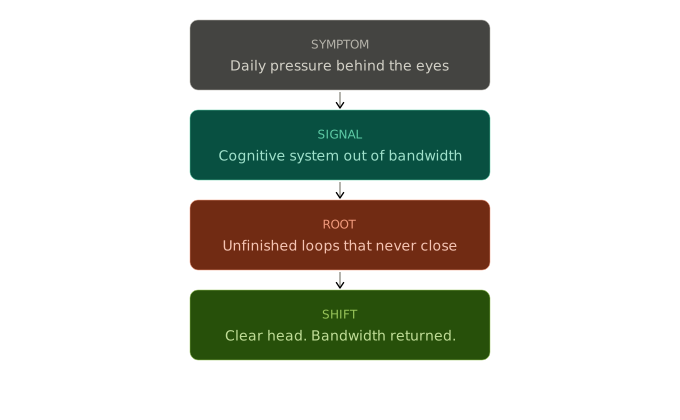
Here's what's actually happening: the brain stays open on tasks, decisions, and conversations that haven't been closed. Each unfinished item — the email you haven't replied to, the conversation you've been putting off, the decision you can't quite make, the project waiting on your input — keeps a small allocation of cognitive resource running in the background. You're not consciously thinking about most of them. They're still consuming bandwidth.
By mid-afternoon, the system is running too many of these background processes simultaneously. The pressure behind your eyes is the felt sense of cognitive overload. Your brain is, quite literally, signalling that it's out of RAM.
This is why standard advice about hydration, posture, or screen time misses. The headache isn't a hardware problem — it's a bandwidth problem. Adding more water to a brain that's running 30 unresolved processes doesn't create more processing power. It just gives you a well-hydrated brain that's still overloaded.
The default underneath this is an unfinished loop pattern. Things stay open because closing them feels uncomfortable, risky, or premature. Often it's paired with a perfectionism pattern that prevents closure — "it's not done until it's perfect," "I'll send it when it's ready," "I'll decide when I have all the information." Neither standard is achievable in practice, so nothing closes. And the loops compound.
There's often a secondary layer: the belief that holding everything open simultaneously is a form of diligence. You're not avoiding — you're keeping your options open, staying responsive, thinking it through. The headache is the cost of that strategy made physical.
Your head isn't the problem. It's the report.
Sources: Chronic stress and tension-type headache — PMC
Cognitive performance and tension headache — Egyptian Journal of Neurology
What changes when the pattern is addressed
When the unfinished loop pattern is resolved — decisions get made, conversations get closed, perfectionism gets recalibrated — cognitive load drops significantly. The headaches diminish, often without any other intervention. The pressure behind the eyes lifts. Mid-afternoons stop being a wall.
More importantly, mental clarity returns. People describe it as their head feeling clear for the first time in years. Not just the absence of pain — the presence of capacity. The bandwidth that was being consumed by 30 open loops becomes available for the few things that actually matter.
The headaches, when they happen at all, become rare and traceable to something specific — not a constant background presence that's been part of your life for years. This is what actual tension headache relief looks like at the root. Not another treatment cycle. Not another pill. A different relationship with the load that was generating the pattern in the first place. (Explore the approach behind this work)
Sources: Diurnal patterns in tension headache — PMC
Your head isn't broken.
The pattern underneath it is.
Lead Yourself First.
What causes tension headaches every day?
For chronic daily tension headaches, the most common cause isn't physical — it's cognitive load. When your brain holds too many unresolved tasks, decisions, and conversations simultaneously, the sustained background activation shows up as a daily pressure across the forehead and behind the eyes. Treating each headache addresses the symptom. Addressing the cognitive load addresses the cause. If your headaches are daily and don't have a clear physical trigger, the mental load is almost always the driver.
What's the best treatment for chronic tension headaches?
The most effective chronic tension headaches treatment isn't a treatment in the medical sense — it's addressing what's generating them. Standard interventions (medication, muscle relaxants, physical therapy, magnesium, hydration) manage symptoms. They can help acutely. But the pattern returns unless you address what's actually driving it. For chronic sufferers, that's almost always cognitive overload from unclosed loops. When the pattern underneath changes, the headaches reduce — often without needing ongoing treatment.
How do I tell if my headache is from stress?
The clearest signal is the pattern. Stress-related tension headaches recur in a predictable rhythm — most days, building through the afternoon, worse during high-pressure periods, often worse on Sunday evenings before the week starts. They respond temporarily to rest and painkillers but return when the cognitive load returns. If your headaches don't have a clear physical trigger and your bloodwork has come back normal, the cause is almost certainly upstream of the headache itself.
How do I get tension headache relief that actually lasts?
Short-term relief is straightforward: painkillers, rest, hydration, a cold compress. Lasting relief requires addressing what's generating the headaches. If the underlying pattern is cognitive overload, no amount of short-term relief will stop them from returning. The relief that lasts comes from reducing the load — closing loops, making decisions, letting go of perfectionism patterns that prevent closure. Not because it's an easier fix. Because it's the only one that changes the cause.
Is it normal to get tension headaches every day?
Common, but not normal. Daily headaches indicate that your nervous system has been operating in a state of chronic activation for long enough that the body is now reporting it consistently. The goal isn't to manage daily headaches better. The goal is to stop having daily headaches.
When should I see a doctor about my headaches?
If your headaches are new, severe, accompanied by visual changes or neurological symptoms, or significantly different from your usual pattern, a medical assessment is the right first step. This page addresses the kind of headache that's been recurring for months or years, with no clear medical cause on examination, and that doesn't respond to standard treatment.
Related signals
Overthinking loops that go nowhere
If your head feels full all day, the loops are part of why. Each unresolved thought, each circling decision, consumes cognitive bandwidth — and the pressure behind your eyes is what that load feels like in the body.
Fatigue that sleep doesn't fix
Cognitive overload doesn't just cause headaches. It drains you in ways that don't show up until evening. If you're hitting a wall at 4pm and the pressure is building at the same time, that's not coincidence. That's the same system reporting from two angles.
Nervous stomach, bloating, and gut issues
The head and the gut are reporting the same nervous system from different locations. If both arrive together — pressure behind the eyes, knot in the stomach — that's not two problems. That's one pattern showing up in two of the most sensitive systems your body has.