
How to stop procrastinating
on the things that matter most
You clear your inbox. You reorganise your task list. You prepare extensively, read one more article, make one more coffee. And the thing that would actually move the needle — the conversation, the decision, the work that requires something real from you — stays untouched. If you're searching for how to stop procrastinating, you've probably already tried the tools. Time blocking, accountability partners, productivity apps, the Pomodoro technique. They help with low-stakes tasks. They consistently fail on the things you actually care about. This page explains why — and what changes when you address the root.
What chronic procrastination actually looks like
It doesn't look like doing nothing. That's what makes it hard to name.
It looks like being busy — genuinely busy — while the most important thing remains untouched. You respond to every email. You attend every meeting. You make real progress on a dozen secondary tasks. And the one thing that would actually change your situation sits in your peripheral vision, circled, deferred, carried forward to tomorrow's list.
The gap between what you're capable of and what you're producing on that specific thing is the tell. You can execute at a high level across most of your work. But this particular task — the one that matters most — triggers something different. A subtle resistance. A sudden need to do something else first. A convincing story about why today isn't quite the right time.
Chronic procrastination is particularly disorienting because it's selective. You're not a procrastinator by nature — you deliver. Which makes the avoidance of this specific thing feel like a personal failure rather than a recognisable pattern.
What most advice gets wrong about
how to not procrastinate
The standard toolkit is well-documented: break the task into smaller steps, use a timer, remove distractions, build accountability, reward yourself for starting, eat the frog. There are entire books, apps, and productivity systems built on these principles.
For ordinary procrastination — low-stakes tasks that feel tedious — some of these tools work. But for the specific pattern of avoiding things you genuinely care about, they consistently fail. Because the problem isn't the size of the task or the absence of a system. The problem is the threat the task carries.
When something matters — when failure would feel like exposure, when judgment is possible, when the outcome reflects something real about who you are — the nervous system treats it differently. A timer doesn't touch that. An accountability partner doesn't either. The avoidance restarts as soon as the external structure is removed, because the internal driver hasn't changed.
This is why "overcoming procrastination" through productivity systems usually fails for the people who need it most. The systems target the wrong layer. The fix isn't a better routine. It's understanding what the procrastination is protecting you from.
Procrastination isn't laziness.
It's self-sabotage protecting you from something.
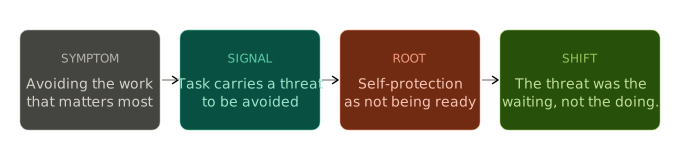
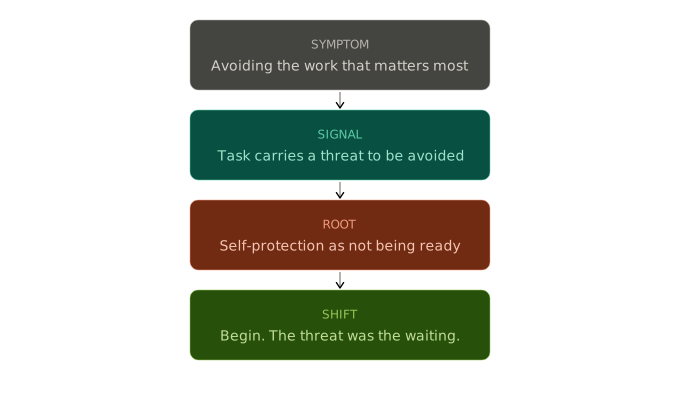
Here's what's actually happening: the task you're avoiding carries a threat. Not a physical threat — a psychological one. Failure on this specific thing would mean something. Being judged. Being exposed as not good enough. Making the call that turns out to be wrong. Putting something real into the world and having it rejected.
The avoidance is the nervous system's way of keeping that threat at arm's length. As long as the task isn't started, it can't fail. As long as the conversation isn't had, the outcome remains uncertain rather than bad. The procrastination is protection — costly, counterproductive protection, but protection nonetheless.
This is what gets called task avoidance in the research literature, and what most people experience as self-sabotage in their lives. You watch yourself avoid the thing that matters most. You know it's not in your interest. You do it anyway. That's not a discipline failure. That's a protective pattern running underneath your conscious intent.
The pattern runs in two forms. The first is pure avoidance — "if I don't try, I can't fail" — dressed up as not being ready yet. The second is the perfectionism default: "I'll start when conditions are right" — and the conditions are never quite right, because the standard is unmeetable by design.
Both share the same root: the belief that performance on this task is tied to personal worth. If it goes wrong, it says something about you. That belief is what makes the task feel threatening. And that belief is what needs to change — not your productivity system.
Self-sabotage isn't a character flaw. It's a strategy your nervous system built to keep you safe from a threat that no longer exists.
What changes when the pattern is addressed
When the self-protection pattern is addressed at its root — the belief that performance on this task defines personal worth — the drag disappears. Not through discipline, not through accountability frameworks, not through breaking the task into smaller pieces.
The moment of beginning stops being charged. People describe sitting down and starting things they've circled for months and being surprised by how straightforward it was. The gap between the imagined difficulty and the actual experience of doing it collapses.
The difficult conversations start happening. The decisions get made. The pivots happen. The thing that was taking up ambient mental space for weeks resolves in an afternoon. The energy that was going into avoidance becomes available for execution. And the compound effect of consistently doing the thing that matters — rather than everything around it — changes outcomes in ways that no productivity system could.
This is what overcoming procrastination actually looks like at the root. Not better discipline. Not more accountability. A different relationship with the threat that was driving the avoidance in the first place. (Here's how that work actually happens.)
Sources: A Lack of Focus, Not Task Avoidance, Makes the Difference: Work Routines in Procrastinators and Non-Procrastinators (PMC, 2023)— PMC
The work isn't the problem.
The pattern underneath it is.
Lead Yourself First.
How do I stop procrastinating on things that matter?
Not through better discipline or a new productivity system. Those address the wrong layer. The procrastination you can't push through is usually fear in disguise — fear of failure, of judgment, of exposure. When the fear is addressed, the procrastination collapses naturally. You don't have to force yourself to start. The threat that was keeping you from starting stops running.
What causes chronic procrastination?
At root, fear. Most commonly fear of failure, judgment, or exposure. The procrastination is the strategy the nervous system has developed to keep that fear at distance. Productivity tools don't address it because they're aimed at the wrong layer. Chronic procrastination stops when the fear stops driving — which means addressing what the task represents, not how to schedule it.
How can I stop self-sabotage and procrastination?
By recognising that self-sabotage isn't really sabotage — it's protection. The pattern is running because somewhere underneath, completing the task feels more dangerous than avoiding it. When you find what the threat actually is — usually being wrong about something important, being judged, being seen as not good enough — and address that directly, the self-sabotage stops. You stop having to fight yourself, because the part of you that was protecting you has different information.
Is procrastination linked to anxiety?
Yes — closely. Procrastination and anxiety share the same root: a nervous system that treats certain outcomes as threats. The procrastination is the behavioural expression. The anxiety is the felt experience. They reinforce each other: avoiding the task generates more anxiety, which generates more avoidance. Addressing the underlying threat usually reduces both at the same time.
What is task avoidance and how do I stop doing it?
Task avoidance is the technical term for what most people experience as procrastination on specific things. It's the behavioural pattern of staying busy with secondary tasks to avoid the primary one. It happens because the primary task carries a perceived threat the secondary tasks don't. You don't stop it through willpower — you stop it by addressing what the primary task is threatening. When the threat dissolves, the avoidance dissolves with it.
Is procrastination a mental illness?
No. It's a learned pattern, not a clinical condition. That said, chronic procrastination can be associated with anxiety, depression, and ADHD — and when it's part of a larger picture, those conditions need their own attention. As a stand-alone pattern, procrastination on important things is most often a self-protection strategy that responds well to addressing what's being protected against.
Related signals
Overthinking loops that go nowhere
Procrastination and overthinking are often the same pattern in different directions. One avoids starting. The other circles endlessly without landing. Both protect against the same thing: being wrong about something that matters.
Why you're so irritable all the time
Carrying around undone work that matters costs you more than you realise. The weight of avoidance is one of the quieter contributors to a short fuse — because the part of you that knows it's not getting done is paying a price all day.
Fatigue that sleep doesn't fix
The energy you're spending on avoidance is energy you don't have for anything else. Tasks you haven't started consume bandwidth even when you're not actively thinking about them. By evening, you're spent — not from doing, but from not doing.