Fatigue that sleep doesn't fix
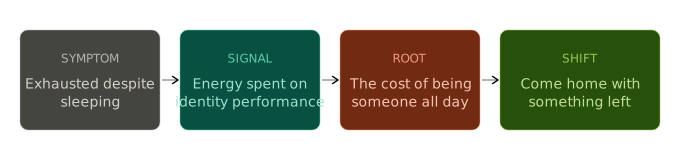
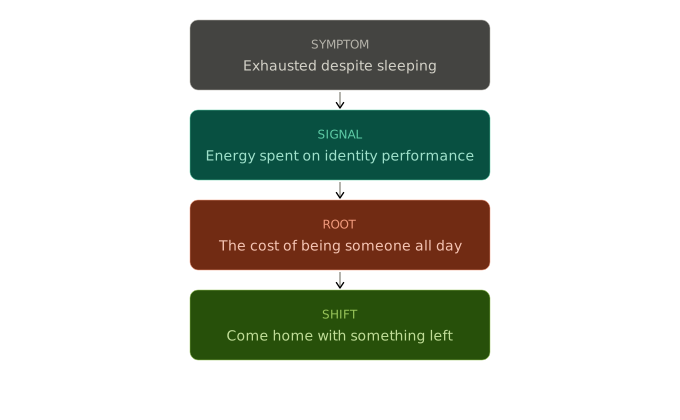
You're getting the hours. Eight, sometimes nine. You do everything right — early enough, no screens, maybe even a wind-down routine. And you wake up tired. Not groggy-tired. Tired in a way that sits behind your eyes and stays there all day. By mid-afternoon it's heavier. By evening you have nothing left. This isn't a sleep problem. It's a signal that something else is consuming your energy — something no amount of rest will touch until you understand what it actually is.
What this fatigue actually feels like
It's not the tiredness that follows a hard physical day — the kind that sleep genuinely fixes. This is different. You wake and the heaviness is already there. The first hour of the day takes effort that shouldn't be necessary. Coffee helps briefly, then doesn't.
By mid-morning you're functional but not sharp. By early afternoon, focus is fragile. The simplest decisions take longer than they should. You push through because you always push through — but the baseline you're pushing from keeps dropping.
What makes this particularly confusing is that you can't point to a cause. You didn't run a marathon. You didn't pull an all-nighter. You just... lived your day. And somehow that cost everything you had.
For high performers this fatigue often goes unnamed for years. It gets filed under "that's just how it is" or "I'm not a morning person" or "I need a holiday." None of those explanations are wrong exactly. None of them are right either.
What most advice gets wrong about chronic tiredness
The standard advice covers sleep hygiene, nutrition, hydration, exercise, and — if you push further — thyroid panels and iron levels. These are worth ruling out. But for most high performers who've already done that due diligence, the results come back normal. And the fatigue remains.
The reason conventional advice misses is that it treats fatigue as an input problem — not enough sleep, not enough nutrients, not enough recovery time. Add more inputs, fix the fatigue.
But this kind of tiredness isn't a deficit of inputs. It's a cost of outputs — specifically, the continuous output of managing, performing, and containing yourself through an entire workday. That cost doesn't show up on a blood panel. And it doesn't respond to an earlier bedtime.
You're not tired from doing too much. You're tired from being someone all day.
Here's what's actually happening: the version of you that shows up at work costs more energy than you think — because it's not fully you. Every interaction that requires you to manage how you come across, contain what you actually feel, project confidence while running on uncertainty, hold space for a team while quietly absorbing pressure — all of that is energy expenditure. Continuous, invisible, and completely unaccounted for.
This is called the identity performance default. The nervous system is running a second job alongside your actual job: the job of being the right version of you in every context. Sales leaders hold the energy in the room. Founders perform certainty while feeling anything but. Reps stay warm and motivated through rejection cycles. None of this is weakness. All of it costs.
The fatigue at the end of the day isn't from what you did. It's from who you had to be while doing it. And sleep — however much of it you get — cannot restore what emotional labour took. Because emotional labour doesn't draw from your physical battery. It draws from something deeper.
You don't need more sleep.
You need to stop spending so much energy being someone.
Sources: Emotional labour and occupational fatigue — NIH/PMC
Identity performance and energy depletion — Frontiers in Psychology
How this fatigue shows up depending on your role
For sales leaders: You lead the room. You hold the energy when the team is anxious. You stay steady through the difficult conversations, the missed targets, the upward pressure. And by 7pm you have nothing left — not for the people at home, not for yourself. The work wasn't that hard. The performance of it was.
For founders: You're not burning out from the workload. You're burning out from the performance of certainty while running on uncertainty. Every investor call, every team all-hands, every strategic decision made in public while privately unsure — that gap between what you project and what you carry is where the energy goes.
For sales reps: You finished a full day of calls and somehow feel more depleted than if you'd run ten kilometres. That's not weakness and it's not the job. That's the cost of emotional labour nobody talks about — the constant calibration of tone, energy, and resilience across every interaction, regardless of what's happening underneath.
What changes when the pattern is addressed
When the identity performance default is dismantled — when people no longer have to run a second job of being the right version of themselves all day — the energy cost of the day drops significantly.
They come home and still have something left. Not because they did less. Because who they were at work and who they actually are started to converge. That gap closes. And the energy that was spent bridging it becomes available again.
This is one of the most consistent and surprising shifts people report: not needing to recover from their own day. The evenings open up. Relationships improve — not because of relationship work, but because there's a person actually present in them. Energy becomes more stable across the week, not just on Monday morning after a good weekend.
The fatigue doesn't disappear because you did less. It disappears because you stopped spending energy you didn't know you were spending. (Here's how that work actually happens.)
The 3am wake-up was never the problem. It was the report card. And once the system shifts, the report changes too.
Sources: Emotional exhaustion and self-monitoring in professional roles — NIH/PMC
Your tiredness isn't broken.
The pattern underneath it is.
Lead Yourself First.
Why am I tired even after 8 hours of sleep?
Because the fatigue isn't coming from lack of sleep — it's coming from the continuous energy cost of emotional labour and identity performance during your working day. Sleep restores physical energy. It doesn't restore what managing, containing, and performing yourself all day depletes. Those are different systems.
Is this kind of tiredness a sign of burnout?
It can be an early signal on the trajectory toward burnout — particularly when the gap between who you are and who you perform at work is wide and sustained over time. On its own it doesn't confirm burnout, but it does indicate the system is running a hidden cost that compounds over weeks and months without intervention.
What is the #1 cause of fatigue that sleep doesn't fix?
For high performers specifically, the primary driver is emotional labour — the invisible work of regulating how you come across, containing what you actually feel, and sustaining a performance of confidence or certainty through a full working day. This cost is real, measurable, and completely separate from physical tiredness.
When should fatigue be a medical concern?
If your fatigue is accompanied by significant unexplained weight change, persistent low mood, pain, or other physical symptoms, a GP visit is the right first step to rule out physiological causes. This page addresses the kind of fatigue that comes back normal on every test — where the cause is nervous system load rather than physical pathology.
Related signals
Sunday dread / Monday heaviness
If the fatigue follows you through the week, Sunday is often where it becomes impossible to ignore. The same identity performance cost that drains your evenings is what makes Monday feel heavy before it's even started.
Waking up at 3am
If Sunday dread is your nervous system pre-loading threat before the week starts, the 3am wake-up is what happens when it doesn't stop there. Same pattern, different hour. Your brain surfaces everything it couldn't process during the day — and does it at the worst possible time.