
Sunday scaries aren't about Monday
That creeping heaviness that arrives Sunday afternoon. The way your mind starts running the week before it's started. The inability to actually enjoy the evening because Monday is already in the room. Most people call it Sunday scaries and assume everyone feels this way. Many do — but that doesn't make it normal. It's your nervous system doing something specific: pre-loading threat before any threat exists. This page explains what's actually happening, why it keeps recurring, and what changes when you address the pattern underneath it.
What Sunday dread actually feels like
It starts earlier than you'd expect — sometimes Saturday evening, sometimes Sunday morning, but almost always by mid-afternoon. A low-level tension that sits behind everything you do. You're technically relaxing. You might even be doing something enjoyable. But there's a background hum that won't quiet down.
By Sunday evening it's harder to ignore. The jaw tightens slightly. Shoulders creep up. A vague restlessness makes it difficult to settle. You pick up your phone and check work email — not because anything is urgent, but because somehow engaging with the threat feels better than waiting for it. Sleep, when it comes, is light. And Monday morning often arrives feeling like you never really stopped.
What makes this particularly insidious for high performers is that it steals the one part of the week meant for recovery. You're present in body at the weekend. Your nervous system is already at work.
What most advice gets wrong about Sunday anxiety
Search "Sunday scaries" and you'll find the same cluster of advice: plan something fun for Sunday evening, write a to-do list to "get ahead," limit work email checking, practice gratitude, do a wind-down routine.
These aren't useless. But they address the surface experience, not what's generating it. A wind-down routine doesn't rewire a conditioned stress response. Planning Sunday dinner doesn't discharge the unresolved weight you're carrying from last week. Getting ahead on Monday's tasks can actually reinforce the pattern — because it teaches your nervous system that the only relief available is re-engaging with the source of the threat.
The reason conventional advice offers limited relief is that Sunday dread isn't a scheduling problem, a mindset problem, or a time management problem. It's a nervous system problem. And the nervous system doesn't respond to logic — it responds to pattern change.
Sunday dread is a conditioned response, not a character trait
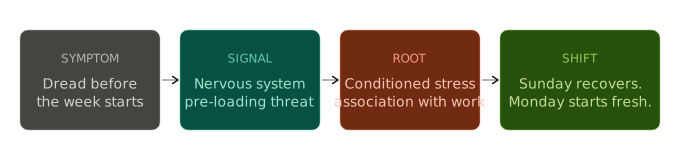
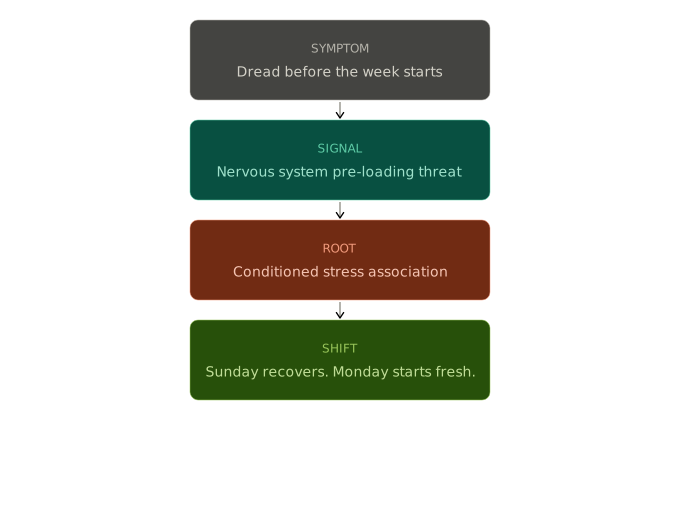
Here's what's actually happening: your nervous system has learned, through repeated experience, that Monday means threat — pressure, performance, judgment, unresolved problems. That association has been reinforced often enough that the anticipation of Monday now triggers the same physiological response as Monday itself.
This is called anticipatory stress. It's not irrational. It's your threat-detection system doing exactly what it was designed to do — preparing you for danger it has learned to expect. The problem is that it's activating 36 hours early, consuming the recovery time your performance actually depends on.
The default underneath this pattern is a chronic stress association with work identity. When work has become the primary source of threat in the nervous system's threat map, the mere anticipation of work is enough to trigger the response. And every Sunday this happens, the association deepens.
There's often a second layer: last week's unresolved weight. Decisions that weren't made. Conversations that weren't had. Things that were pushed forward rather than closed. The nervous system is carrying those open loops into Sunday — and the dread is partly the weight of what wasn't discharged.
Sunday dread isn't anxiety about next week. It's last week, unprocessed, bleeding into the only time you had to recover.
Sources: Stress anticipation and cortisol activation — Frontiers in Psychology
Conditioned stress responses and anticipatory anxiety — NIH/PMC
How Sunday scaries show up depending on your role
For sales leaders: Sunday evening feels like a countdown. Not because anything bad is happening — but because your nervous system has learned that Monday means managing a number, a team, and upward expectations simultaneously. The dread isn't weakness. It's a system that's been running on high alert for so long it no longer knows how to stop, even when you're technically off.
For founders: The dread isn't usually about next week's tasks. It's about carrying last week's unresolved weight — the decision you didn't make, the conversation you avoided, the strategic uncertainty you pushed forward — into the next seven days. Sunday becomes the moment all of that surfaces, with nowhere useful to go.
For sales reps: Monday morning anxiety so familiar it feels like part of the job. It's not. The back-to-back calls, the pipeline pressure, the quota sitting in your peripheral vision all weekend — your nervous system has fused work threat with work identity. The anxiety is the signal that the association needs to change, not that the job is inherently intolerable.
What changes when the loop gets cleared
When the stress association with work is deconditioned — and when last week's weight is genuinely discharged rather than carried forward — Sunday evening becomes Sunday evening again.
The dread lifts. Not through discipline or reframing or forcing yourself to be present. But because the nervous system no longer has a reason to fire. The pattern has changed at the root, and the conditioned response has nothing left to run on.
This is often the shift that family members notice first. The person is actually present at the weekend. Actually relaxed — not performing relaxation while mentally running pipeline review. For high performers who've lived in Sunday dread for years, this can feel almost implausible the first time they experience it. Then it becomes the new normal.
And the energy carried into Monday from a genuinely recovered weekend changes the quality of the entire week. Not marginally — significantly. The starting point is different. The first hours are different. The decisions made before 10am are different.
This is what the work addresses. Not the symptom on Sunday evening. The pattern that's been generating it for years. (Here's how that work actually happens.)
The 3am wake-up was never the problem. It was the report card. And once the system shifts, the report changes too.
Sources: Anticipatory stress and weekend recovery — NIH/PMC
Your Sunday evenings aren't broken. The pattern underneath them is
Lead Yourself First.
Is Sunday dread the same as anxiety?
Sunday dread is a form of anticipatory stress — a conditioned nervous system response rather than a clinical anxiety disorder. It shares the same physiological mechanics as anxiety (cortisol activation, threat-detection firing) but it has a specific trigger: the anticipation of work. That specificity is useful, because it means the pattern can be addressed at its root.
Why do I feel Sunday dread even when work is going well?
Because the nervous system responds to learned associations, not current reality. If work has been a source of sustained pressure over months or years, the body has been conditioned to treat its anticipation as a threat — regardless of what's actually on your calendar. The dread isn't a logical assessment of next week. It's a pattern running on old data.
Is Sunday dread a sign of burnout?
It can be an early signal that the nervous system is chronically activated and not recovering adequately between weeks. On its own it doesn't confirm burnout — but it does indicate that the recovery window the weekend is supposed to provide isn't functioning. That gap between demand and recovery, sustained over time, is the trajectory toward burnout.
Why does getting ahead on work tasks not help?
Because it reinforces the pattern rather than breaking it. When you re-engage with work to relieve Sunday anxiety, the nervous system learns that work engagement is the only available relief — which deepens the association between work and threat management. Short-term relief, long-term reinforcement.
Related signals
If you're waking at 3am, your jaw is often doing this too.
Jaw clenching that won't release
You've tried the mouth guard. The massage. Maybe the Botox. The jaw still tightens by 10am and stays locked through the day. There's a reason — and it's not dental.
Waking up at 3am
If Sunday dread is your nervous system pre-loading threat before the week starts, the 3am wake-up is what happens when it doesn't stop there. Same pattern, different hour. Your brain surfaces everything it couldn't process during the day — and does it at the worst possible time.