Overthinking loops that go nowhere
You've thought about it thirty times. You have all the information you need. And you're still circling. The decision doesn't get clearer. The plan doesn't get better. The email doesn't get sent. Most people call this overthinking and treat it as a character flaw — something to push through with discipline or manage with mindfulness. It's neither. Overthinking is what the mind does when it doesn't feel safe to decide, act, or let go. This page explains what's actually running the loop — and what changes when you address it at the root.
What an overthinking loop actually feels like
It's not confusion. You usually know what you think. It's the circular return to the same territory — the same decision, the same conversation, the same problem — without resolution. Each pass feels like it might be the one that finally settles it. It never is.
The loop tends to activate most in the moments that matter most. Before a high-stakes conversation. After a decision that can't be undone. Late at night when there's nothing to distract from it. The more important the thing, the tighter the loop.
What makes it particularly exhausting is that it feels productive. You're thinking hard. You're being thorough. You're not avoiding — you're preparing. Except nothing gets decided. Nothing gets done. And the energy spent circling is energy that won't be there when you actually need to act.
For high performers this pattern often runs for years unnoticed, because the people around them interpret it as diligence. It gets rewarded. And so it deepens.
What most advice gets wrong about overthinking
The standard approach treats overthinking as a thinking problem — too many thoughts, too much analysis, too little mindfulness. The prescription follows: journal it out, set a decision deadline, do a pros and cons list, meditate, breathe.
These tools aren't useless. But they address the surface activity — the looping thought — not what's generating it. A pros and cons list doesn't resolve the fear of being wrong. A decision deadline doesn't touch the underlying belief that more thinking equals more safety. Mindfulness can create temporary distance from the loop, but without addressing the root, the loop restarts.
The reason conventional advice offers limited relief is that overthinking isn't a cognitive surplus. It's an emotional response wearing the costume of rational analysis. And you can't think your way out of a pattern that thinking is generating.
Overthinking isn't thoroughness.
It's the illusion of control.
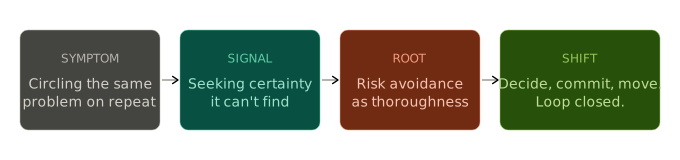
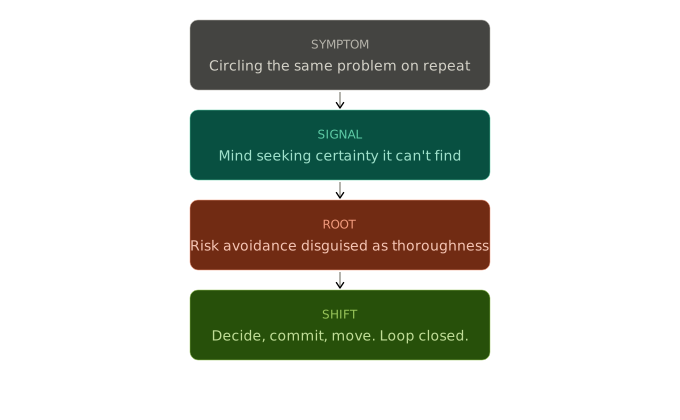
Here's what's actually happening: the mind is circling because it doesn't feel safe to stop. Underneath the loop is a fear — of being wrong, of being judged, of being caught out, of making the call that turns out to be the wrong one. The thinking isn't solving the problem. It's managing the anxiety of having to decide.
This is the risk-avoidance pattern disguised as thoroughness. The brain has learned that as long as it keeps thinking, the decision hasn't been made yet — and as long as the decision hasn't been made, it can't be wrong. The loop is protection. It just costs everything.
There's often a second layer specific to high performers: the belief that the quality of their thinking is tied to their value. Smart people think carefully. Thorough people consider every angle. If the loop feels like intelligence, stopping it can feel like becoming someone less capable. That belief is the deeper root. And it's what keeps the loop running long after the person knows, logically, that they need to just decide.
Overthinking isn't a thinking problem. It's what happens when the
mind tries to find certainty in a situation that doesn't offer it.
Sources: Rumination and cognitive avoidance — NIH/PMC
Risk avoidance and decision-making paralysis — Frontiers in Psychology
How overthinking loops show up depending on your role
For sales leaders: You've thought about that hire decision thirty times. You have the data. You've spoken to the references. You know what you think. But the loop restarts every time you move toward committing. That's not due diligence — that's managing the anxiety of being responsible for someone else's livelihood. The thinking isn't the problem. The fear underneath it is.
For founders: The strategy pivot you've been thinking through for six weeks. Every angle covered, every scenario modelled, every risk identified. And still no decision. You don't need more data. You need to feel safer making the call. The loop isn't protecting your company — it's protecting you from the discomfort of being the one who chose.
For sales reps: You've rewritten the email eleven times. Every version is fine. You know it's fine. But you read it again anyway, change a word, read it again. That's not perfectionism — it's fear of rejection wearing perfectionism's clothes. The loop keeps you technically busy while keeping the actual risk at arm's length.
What changes when the pattern is addressed
When the risk-avoidance pattern is addressed at its root — the fear of being wrong, judged, or exposed — the loop collapses. Not because the person becomes reckless or stops thinking carefully. But because they develop a different relationship with uncertainty.
Decisions that took weeks start taking hours. Sometimes minutes. The process of thinking through something still happens — but it reaches a natural conclusion rather than restarting. People describe a new capacity to make a call, commit to it, and move without the loop restarting behind them.
For leaders and founders this changes everything: execution speed, team confidence, the quality of presence in a room. When you're not carrying three unresolved decisions into every meeting, you're actually there. People notice.
The relief of being someone who decides is significant. And the energy that was spent circling becomes available for what comes after — which turns out to be where most of the actual value was waiting. (Here's how that work actually happens.)
Sources: Decision-making and prefrontal cortex regulation — NIH/PMC
Your thinking isn't broken.
The pattern underneath it is.
Lead Yourself First.
Why do I overthink everything?
Overthinking is the mind's attempt to find certainty in situations that don't offer it. When the nervous system has learned that being wrong carries significant threat — judgment, rejection, exposure — the brain responds by looping. More thinking feels like more safety. It isn't, but the pattern runs until the fear underneath is addressed rather than managed.
Is overthinking a symptom of anxiety?
They share the same root: a nervous system that has learned to treat uncertainty as threat. Overthinking is often how that threat response shows up in high performers — people who are too functional to call it anxiety, but whose minds never fully stop running. It's the same pattern, more socially acceptable packaging.
Can overthinking be cured?
Cure isn't the right frame. The thinking capacity that drives the loop is also what makes high performers effective — the ability to consider angles, anticipate problems, think carefully. The goal isn't to remove that. It's to address the fear that turns useful thinking into a loop that never lands. When the root changes, the thinking stays. The circling stops.
Is overthinking linked to high IQ or intelligence?
The loop often gets misread as intelligence — and high performers frequently use thoroughness as cover for what is actually risk avoidance. Smart people think carefully; the pattern exploits that belief. Genuine strategic thinking reaches conclusions. Overthinking loops. The difference isn't cognitive capacity — it's the fear underneath.
Related signals
Sunday dread / Monday heaviness
Overthinking loops don't clock off at the weekend. If Sunday evening triggers a replay of everything unresolved from the week — the decision not made, the conversation avoided — that's the same pattern, different day.
Fatigue that sleep doesn't fix
Overthinking loops don't just cost decisions — they cost energy. Running the same problem on repeat is one of the heaviest invisible drains on your system. If the loop is familiar, the fatigue probably is too.